

Anthropic's $965 Billion Valuation Reverses the AI Pecking Order
Anthropic's $965 billion valuation now sits above OpenAI's $852 billion March valuation. In private markets, that shift mostly shows investor preference. In public markets, it becomes a pricing test.
Both companies are expected to go public as soon as in the fall, so the next IPO window should do more than extend the private-market narrative. It will show how far public investors are willing to go to fund frontier AI before profitability is proven.
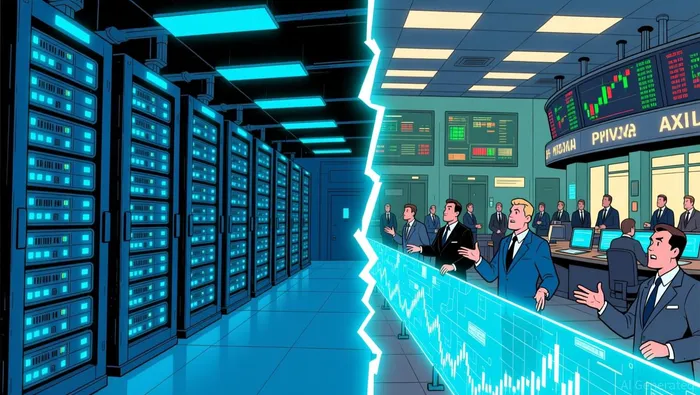
The core tension is straightforward. Bulls see a race to control compute, model capability, and enterprise distribution. Bears note that neither company is profitable, so public buyers would still be underwriting future conversion rather than current earnings.
Anthropic Is Being Valued as AI Infrastructure, Not Just a Model Vendor
Strategic investors point to a compute bottleneck
The latest funding round highlights where investors think the bottleneck sits. Anthropic brought in strategic backing from Micron, Samsung, and SK hynix, companies deeply involved in memory and chip supply. That matters because frontier AI depends on more than model quality; it depends on reliable access to compute, memory bandwidth, and power.
Anthropic is also locking in large-scale capacity. It has agreements for up to five gigawatts with Amazon, plus additional next-generation TPU capacity through Google and Broadcom and GPU access through SpaceX. Those commitments suggest investors are underwriting a company that could become part of the AI stack itself.
Revenue growth gives the infrastructure story substance
The infrastructure thesis only works if demand keeps rising. Anthropic's revenue trajectory has been steep: annualized revenue moved from $9 billion at the end of last year to $30 billion in April and then to $47 billion this month. That kind of growth helps explain why investors are willing to fund compute expansion and enterprise partnerships before the valuation debate is settled.
The mechanism is simple. Strong adoption raises the value of extra compute and distribution; more compute can support better capability and lower latency; better capability can attract more enterprise workloads. If that cycle holds, Anthropic starts to look less like a standalone model vendor and more like critical AI infrastructure.
The main risk is execution. If capacity arrives late or enterprise demand does not translate into durable platform usage, the market can quickly re-rate the company from infrastructure owner back to expensive high-growth lab.
The Public-Market Test Is Whether the Math Holds Up
Why bulls are willing to delay profitability
Bulls do not need perfection. They need evidence that scale and infrastructure control can come first. OpenAI's completed $122 billion raise, along with a $35 billion contingent tranche, shows that well-capitalized backers are prepared to fund years of compute expansion before the income statement is clean.
Why bears still have the cleaner objection
Bears can point to a simpler problem. These companies would be entering public markets after lucrative stints as private companies, and neither OpenAI nor Anthropic is profitable. That means IPO buyers would be paying for expectations, not earnings.
Cerebras offers a useful early template. Its IPO was priced at $185, the stock rose 68% on its first trading day, and then fell 10% the next day. The takeaway is not that demand for AI infrastructure exposure is weak. It is that public investors may eagerly chase the theme, but they will still punish weak discipline the moment shares trade daily.
The real public-market question, then, is not whether AI demand is real. It is whether Anthropic and OpenAI can pair scale with enough operating credibility to survive public-market price discovery.
IPO Timing, Prospectus Detail, and Supply Will Decide the Next Repricing
OpenAI is reportedly targeting a public listing as early as September, while Anthropic is expected to file before the end of the year. The sequence matters. Whichever company lists first may set the pricing template for frontier AI equity.
Signals worth watching first
- Filing order and disclosure quality: Who reveals compute commitments, customer concentration, and capex plans first, and how much detail does the prospectus include?
- Offer sizing versus market appetite: Too much equity in one window can cap reratings even if the story is strong. combined new equity supply could approach or exceed $135 billion.
- Infrastructure over model FOMO: The cleaner thesis ties demand to power, chips, and enterprise distribution, not just benchmark headlines.
- Post-listing volatility: The Cerebras move shows how quickly speculative enthusiasm can give way to sharper scrutiny.
If the first major AI debut absorbs large supply and still struggles to hold more than a modest premium because investors fixate on burn and weak operating controls, the market will be signaling that the infrastructure-layer story is still ahead of its financial proof.