

Jensen Huang is going back to Korea in June for his second "Kkanbu summit" - a gathering of the country's biggest conglomerate chairs. Samsung and LG shares moved on the news. The headline story, as traded, is about whether more HBM memory orders are coming.
The real story has nothing to do with memory volume. Huang's agenda this time is physical AI - the fusion of artificial intelligence with robots, autonomous vehicles, and smart factory hardware. That is a completely different structural frame from the HBM supply story that has dominated the past two years. And it changes which companies deserve attention, and which ones are getting the narrative wrong.
The supply chain shift that already happened
Let's get the memory picture straight first, because it's the foundation for understanding why Korea matters.
For the Blackwell generation, SK Hynix was essentially Nvidia's exclusive HBM3E supplier - Samsung and Micron were locked out of the highest-quality volume. SK Hynix held roughly 53% of the total global HBM market in the third quarter of 2025, followed by Samsung at 35% and Micron at 11%. In Nvidia-specific supply, SK Hynix was closer to a near-monopoly.
That has changed for the next generation. In March 2026, Nvidia selected both Samsung and SK Hynix as exclusive HBM4 suppliers for the Vera Rubin platform - explicitly cutting Micron out but ending SK Hynix's solo run. Samsung is now projected to capture approximately 30% of Nvidia's HBM4 supply, up from near zero in the Blackwell cycle. Samsung showcased its HBM4E at GTC 2026 in April, signaling mass production readiness.
What this means is straightforward: SK Hynix's structural moat - being the only qualified supplier to Nvidia - is gone. Not eliminated, but diluted. They still get the majority share, probably 60-70%, but Samsung has crossed the qualification barrier that took them years to close. The supply chain has restructured from a single-source bottleneck to a dual-source system. For SK Hynix, pricing power weakens. For Samsung, revenue visibility and margin upside improve.
But this supply chain rebalance is background now. It's already reflected in Samsung's stock action over the past month. The market has been pricing it in. Huang's visit isn't about HBM4 volume allocation - that's already been decided.
Physical AI is the transition frame
Here's what the market is missing. The focus of this Korea trip is physical AI.
Physical AI - the term Nvidia now uses to describe AI systems that interact with the physical world through robots, vehicles, and industrial automation - is the next architectural transition in the compute stack. Training happens in centralized data centers. Inference happens at the edge, inside devices that move, sense, and act. The hardware requirements, the software stack, the customer base, and the economics are different.
Huang is meeting with Samsung Electronics, SK Group, LG Group, and Hyundai Motor Group. That lineup tells you what's being negotiated. Samsung and SK have semiconductor and display exposure. LG brings robotics through its CLOi platform, which already integrates Nvidia chipsets and the Isaac robotics platform. Hyundai brings autonomous driving - the largest single application of physical AI that hasn't yet reached scale.
This isn't a memory supply discussion. It's a question of which Korean company becomes the primary OEM and systems integrator for Nvidia's physical AI stack, in the same way that Samsung and SK Hynix became the primary memory integrators for Nvidia's data center stack.
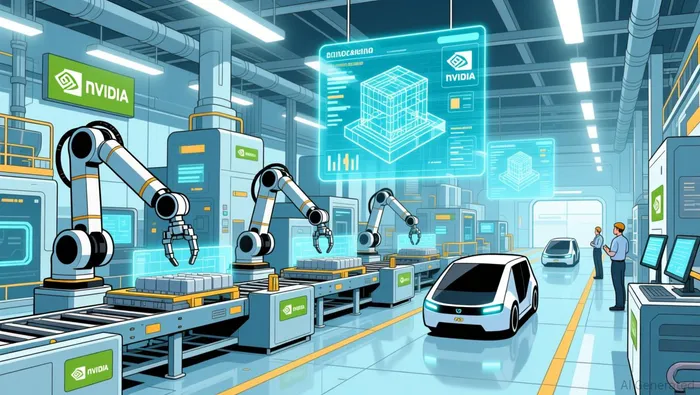
For LG, the thesis is already visible. In May 2026, LG Electronics announced it will convert all 29 global factories into "AI factories" using Nvidia's Omniverse digital twin platform. LG's Isaac robotics partnership means their home and industrial robots run on Nvidia inference silicon. LG is positioning itself as the physical AI systems company - not the chip maker, but the company that ships the devices the chips go into.
That is a fundamentally different value proposition from Samsung's semiconductor play. Samsung makes the components. LG assembles the systems. In hardware-to-software value migration, component suppliers compete on process node and cost. Systems integrators compete on installed base, distribution, and brand trust with enterprise customers. LG has none of the margin leverage of a chip monopoly, but it has the channel advantage - factories, home appliances, and commercial spaces where physical AI actually deploys.
So where should capital go?
The question isn't whether Huang's visit is "good" for Samsung and LG. It's whether the physical AI transition justifies the same allocation as the HBM story did.
I believe it doesn't - yet. Here's why.
Samsung's 30% share of Nvidia's HBM4 supply is real and material. The end of SK Hynix's monopoly is a competitive inflection that improves Samsung's memory economics for the next 2-3 years. That's a supply chain story that has been building for 18 months, and the stock has already run.
But physical AI is back-half weighted. Nvidia's own messaging on the topic has only accelerated in the past 6-9 months. The Korean companies are early in their integration. Hyundai's autonomous driving is years from revenue scale. LG's CLOi robots are a tiny fraction of the company's revenue. Samsung has no meaningful physical AI end-product line.
Put plainly: the HBM story is a 2026-2027 revenue play. The physical AI story is a 2028-2030 revenue play. They require different allocation logic. The HBM shift is priced in. The physical AI thesis is not - because it can't be, yet. The execution risk is higher, the timeline is longer, and the revenue impact on any single company is uncertain.
What this means for allocation: Samsung's HBM4 gain supports a position, but not a new one at these levels. The supply chain transition has been digested. LG's physical AI positioning is more interesting at the margin - the company has actual product integration already underway, not just partnership announcements - but the revenue contribution is too small to carry a large position today. Hyundai is pure optionality on autonomous driving timelines.
The debate is not whether Nvidia is important to Korean semiconductors. It is whether the physical AI narrative justifies the same conviction as the data center story. I believe the answer is no - not right now. The infrastructure transition from centralized training to edge inference is real, but it's a back-half return profile. If you're looking for the next dark horse in the AI trade, physical AI systems integration is the space to watch. It's just not ready for a large allocation.
Demand is not the question. Timing is.